Generative Engine Optimization (GEO): How to Get Cited by ChatGPT, Perplexity & AI Overviews in 2026
TL;DR
Generative engine optimization (GEO) is how you get cited by ChatGPT, Perplexity and AI Overviews in 2026. Here's the practical, agency-tested playbook.

For fifteen years, the goal of search was a blue link on page one. In 2026, a growing share of buyers never see that link. They ask ChatGPT to compare two SaaS tools, ask Perplexity which D2C skincare brand is clean-label, or read Google's AI Overview and never scroll. Google has confirmed AI Overviews now appear on a large and rising share of queries, and independent trackers like BrightEdge and Semrush have measured them on close to half of informational searches. If your brand isn't inside that generated answer, you are invisible at the exact moment of decision.
Generative engine optimization (GEO) is the practice of structuring your content, data, and brand signals so that AI answer engines - ChatGPT, Perplexity, Gemini, and Google AI Overviews - cite and recommend you in their generated responses. It is not a replacement for SEO; it is the layer that sits on top of strong SEO and decides whether you get pulled into the answer or quietly summarised over. At Balistro we now treat GEO as a core deliverable, not a buzzword, because we can see it moving qualified traffic for D2C and B2B clients in India and abroad.
Why GEO matters now (and why SEO alone isn't enough)
Classic SEO optimises for a ranking - position 1 to 10. GEO optimises for inclusion in a synthesised paragraph that may cite three to six sources and send a click to none of them. The behaviour change is real: AI Overviews compress the funnel, and users who do click tend to be further down the consideration path. So the traffic you lose is often low-intent, and the visibility you gain inside answers is high-intent. The brands that win are not necessarily ranking #1 - they are the ones AI models trust enough to quote.
There's a second reason this is urgent for performance marketers. Paid acquisition is getting harder and more expensive. With Meta's signal loss after iOS changes and rising CPMs, plus Google pushing agentic, AI-driven formats like AI Max for Search campaigns, the economics now reward owned, durable visibility. GEO is one of the few channels where a single well-built asset keeps earning citations for months without a media budget behind it. That's why we fold it into the same engine as our paid work and SEO, AEO and GEO services.
How AI answer engines actually choose sources
Each engine works differently, but the patterns rhyme. ChatGPT (with browsing and the SearchGPT layer) and Perplexity both run live retrieval, rank candidate pages, then synthesise. Google AI Overviews lean heavily on content that already ranks and carries strong E-E-A-T signals. Gemini blends Google's index with its own model reasoning. Across all of them, a few things consistently increase your odds of being cited:
- Extractable answers. A clear, self-contained 40-60 word answer near the top of a section is far easier for a model to lift than a meandering 300-word build-up.
- Statistics and specifics. Research from Princeton (the original GEO paper, Aggarwal et al.) found that adding cited statistics, quotations, and authoritative sources measurably raised visibility in generative engines.
- Entity clarity. Models need to know who you are. Consistent brand, founder, and product entities across your site, Wikipedia-adjacent sources, and structured data help.
- Freshness. Perplexity and SearchGPT visibly favour recently updated, dated content for time-sensitive queries.
- Third-party corroboration. Being mentioned on Reddit, review sites, and reputable publications matters more than for classic SEO - models cross-check.
GEO vs SEO vs AEO: what's the difference?
These terms get used interchangeably and shouldn't be. SEO targets ranking in a list of links. AEO (answer engine optimization) targets featured snippets, People Also Ask, and voice answers within Google. GEO targets inclusion and citation inside AI-generated responses across multiple engines. They overlap, but the optimisation tactics and success metrics diverge.
| Dimension | SEO | AEO | GEO |
|---|---|---|---|
| Primary surface | Blue-link results | Snippets, PAA, voice | ChatGPT, Perplexity, AI Overviews |
| Goal | Rank position 1-10 | Win the answer box | Get cited in the generated answer |
| Key lever | Authority, links, intent match | Concise Q&A formatting | Extractable claims, stats, entity trust |
| Success metric | Clicks, rankings | Snippet ownership | Citation share, AI referral traffic |
| Decay risk | Algorithm updates | SERP layout changes | Model retraining and retrieval shifts |
The Balistro GEO playbook: 7 things we actually do
Here is the workflow we run for clients, in roughly the order we deploy it. None of it is theoretical - it's what's currently earning citations.
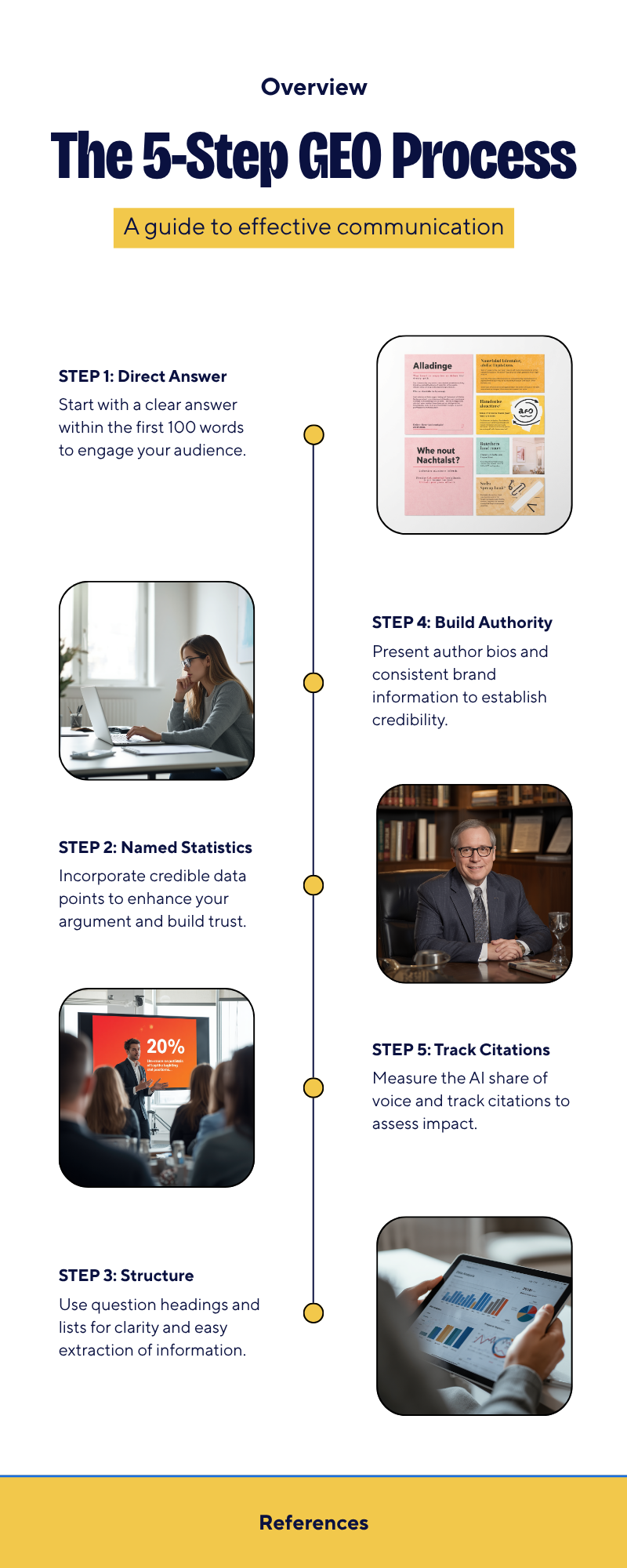
- Lead with the answer. Every important page and post opens with a one or two sentence definition that directly answers the query, written so a model can quote it verbatim. The two opening paragraphs of this very post are built that way.
- Add real, attributed statistics. We cite named sources - eMarketer, Ahrefs, Klaviyo, Google's own announcements - rather than inventing precise-sounding numbers. Models reward sourced claims and penalise unverifiable ones over time.
- Structure for extraction. Short paragraphs, descriptive H2/H3s phrased as questions, comparison tables, and FAQ blocks. Each section should stand alone if lifted out of context.
- Build entity authority. Organization, Person (founders), Product, and FAQPage schema; consistent NAP and brand naming; founder bios that establish credentials (in our case, ex-Dentsu Merkle backgrounds).
- Earn off-site mentions. Digital PR, expert quotes, Reddit and community presence, and review-platform listings. AI models triangulate across sources, so off-site signal is now an on-page concern.
- Keep content fresh. We date and update cornerstone pages quarterly. A 2024 post on a 2026 topic rarely gets cited.
- Measure citation share. We track brand mentions in ChatGPT and Perplexity responses for target prompts, plus AI referral traffic in GA4 (referrers like chatgpt.com, perplexity.ai, gemini.google.com).
The Indian-market angle
For Indian D2C and B2B brands, GEO is an unusually good arbitrage right now. Most local competitors are still running thin, undated content and chasing keyword density. A skincare brand spending a few lakh rupees a month on Meta ads, watching CPMs climb, can build a handful of genuinely authoritative comparison pages and start showing up when someone asks ChatGPT "best affordable clean-beauty brands in India." That citation costs nothing per impression and compounds. We've found the gap between effort and reward is wider in India than in the more saturated US market.
Common GEO mistakes that kill your citations
- Burying the answer. If a reader (or model) has to read 400 words before the payoff, you've already lost.
- Fabricated stats. Made-up numbers get contradicted by other sources and erode trust. Always attribute.
- Blocking AI crawlers indiscriminately. If you disallow GPTBot, PerplexityBot, and Google-Extended in robots.txt, you opt out of citation entirely. Decide deliberately.
- Thin entity signals. No schema, inconsistent brand naming, no founder presence - the model can't tell who you are.
- Treating GEO as one-and-done. Retrieval indexes refresh constantly. Stale content drops out.
FAQ
What is generative engine optimization (GEO)?
Generative engine optimization is the practice of structuring your content, data, and brand signals so that AI answer engines like ChatGPT, Perplexity, Gemini, and Google AI Overviews cite and recommend your brand within their generated responses. It builds on traditional SEO but optimises for inclusion in synthesised answers rather than ranking in a list of blue links.
Is GEO replacing SEO in 2026?
No. GEO sits on top of SEO, not instead of it. Engines like Google AI Overviews still draw heavily from pages that already rank well and carry strong E-E-A-T signals. Strong technical SEO and authority remain prerequisites; GEO adds the formatting, statistics, and entity work that decides whether AI models actually quote you.
How do I get my brand cited by ChatGPT and Perplexity?
Lead each page with a clear, extractable answer, add attributed statistics from named sources, structure content with question-based headings and tables, implement Organization and FAQ schema, and earn third-party mentions on reviews, Reddit, and reputable publications. Keep cornerstone content dated and updated, and allow AI crawlers in your robots.txt.
How do you measure GEO success?
Track three things: citation share (how often your brand appears in AI answers for target prompts), AI referral traffic in GA4 from sources like chatgpt.com and perplexity.ai, and assisted conversions from those visitors. Because AI answers can send fewer but higher-intent clicks, judge quality and pipeline impact alongside raw volume.
Get cited, not summarised over
GEO isn't a side project for 2027 - the answer engines are already deciding which brands get recommended today, and those decisions compound. The brands building extractable, sourced, entity-rich content now will own the AI answer layer while competitors are still arguing about keyword density. If you want a GEO and SEO program that's wired into your paid and retention engine - not run in a silo - talk to Balistro and we'll map where you can win citations first.