How to Get Your Brand Cited by ChatGPT, Perplexity & Google AI Overviews in 2026
TL;DR
I’ll be blunt about something we’ve watched happen to client after client this year. A D2C brand we work with had a blog post sitting at position #2 for a high-volume query. Solid ranking, the kind you’d celebrate.
I’ll be blunt about something we’ve watched happen to client after client this year. A D2C brand we work with had a blog post sitting at position #2 for a high-volume query. Solid ranking, the kind you’d celebrate. Then Google rolled out an AI Overview for that query, and their clicks dropped by roughly half inside a month. The ranking didn’t move. The traffic did. That gap is the whole story of search in 2026, and it’s why I think generative engine optimization is the most important skill a marketing team can build right now.
Generative engine optimization (GEO) is the practice of structuring your content so that AI engines like ChatGPT, Perplexity, and Google’s AI Overviews quote and cite your brand when they answer a question. It’s the successor to classic SEO, not a replacement for it. And in India it has stopped being a nice-to-have: Perplexity crossed 18 million daily queries here in Q1 2026, and that line on the chart is still going up.
Why generative engine optimization beats ranking obsession
Here’s the number that should reframe how you think about organic. Zero-click searches, where someone gets their answer without visiting any site, now make up about 69% of all queries. The AI summary sits at the top, answers the question, and most people never scroll. So you can rank #1 and still watch your traffic erode, because the click you used to earn now goes to nobody.
But there’s a flip side that almost everyone misses, and it’s genuinely good news. Adobe looked at over a trillion retail site visits and found that visitors who arrive from AI sources convert 42% better, spend 48% longer on the page, browse 13% more pages, and produce 37% higher revenue per visit than ordinary traffic. Think about what that means. AI search hands you fewer visitors, but the ones who do come through have already been pre-qualified by the engine. They read the summary, decided they wanted more, and clicked your name specifically.
So the game isn’t “get more clicks.” It’s “be the brand the AI names.” Win the citation and you win that high-intent visitor. Lose it and you lose twice, because your old ranking doesn’t pay the bills anymore.
I think this is where a lot of marketing teams are quietly stuck. They can see traffic softening in their analytics, but the ranking dashboards still look fine, so the problem hides in plain sight. The instinct is to publish more of the same, faster, which usually makes things worse because thin content is exactly what AI summaries replace. The teams pulling ahead did the opposite. They published less, but built each piece to be the source an engine reaches for, and they started measuring whether that was actually happening instead of assuming it was.
How AI engines actually decide who to cite
This part trips people up, so let me be concrete. AI engines don’t rank ten pages and pick a winner the way classic Google did. They pull discrete claims out of content and stitch them into an answer. That single difference changes everything about how you write.
A page that opens a section with three paragraphs of throat-clearing before getting to the point will lose to a page that states the answer in the first sentence. The engine wants something it can lift cleanly. From everything we’ve tested, four signals decide whether you get pulled into the answer:
- Answer clarity. Is there a self-contained, quotable answer in the first 100 words of the section? If the engine has to infer it, it usually moves on.
- Statistical specificity. Princeton’s GEO research found that adding statistics and named-source citations lifted AI citation rates by up to 40%. Numbers with a source behind them get quoted; vague claims get skipped.
- Entity clarity. Does the engine understand who you are, what you do, and where you operate? Inconsistent brand info across the web muddies this.
- Source trust. Authority, editorial corroboration, and plain brand recognition all push your citation odds up.
None of this is exotic. It’s mostly good writing plus a bit of structure. The brands struggling with GEO aren’t bad at marketing; they’re writing for a reader who skims, when they also need to write for a machine that extracts.
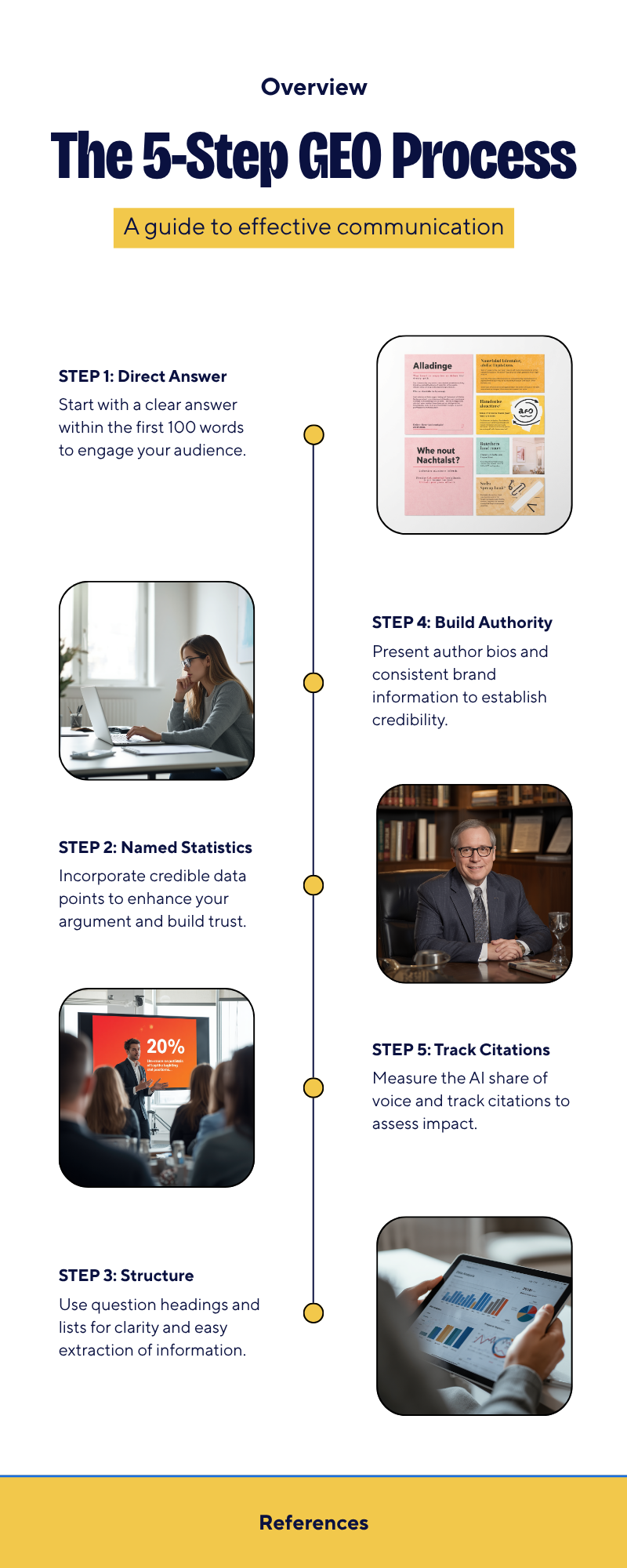
The 5-step GEO process we actually use
1. Lead every section with a direct answer
For each question you want to own, write a one or two sentence answer and put it at the very top of that section. Treat it like a snippet you’re handing the engine on a plate. This one habit moves the needle more than anything else, and it costs you nothing but discipline.
2. Back claims with named statistics
Swap “many brands see strong results” for “D2C brands shifted 30 to 40% of their lifecycle budget to WhatsApp in 2026.” Specific, attributed, quotable. That’s the texture AI engines reach for, and it’s also just more honest writing.
3. Structure so the content is easy to lift
Question-style headings, short paragraphs, lists where lists make sense, and an FAQ block with proper schema markup. The easier you make extraction, the more often you get extracted. Generative engine optimization rewards clarity in a way that classic SEO never quite did.
4. Strengthen your entity and authority signals
Keep your brand details consistent across your site, your schema, and third-party mentions. Put real author names and bios on posts. Share first-hand experience and original data, because search in 2026 is actively favouring content that shows someone actually knows the field rather than content that paraphrases the first page of results.
5. Measure citations, not just rankings
Start tracking which engines cite you, for which questions, and from which pages. Your share of voice inside AI answers is the new ranking report. If you’re still only watching position and organic sessions, you’re grading yourself on last season’s scorecard.
A worked example: rewriting one section for citation
Theory is cheap, so here’s the kind of edit we make in practice. Say a skincare D2C brand has a section headed “About our vitamin C serum” that opens like this: “We’ve spent years perfecting our formulation, drawing on the latest research and a deep commitment to clean ingredients, because we believe your skin deserves the very best.” Lovely sentiment. Completely uncitable. There’s no claim an engine can lift, no answer to any question a buyer is actually typing.
Now the rewrite. We change the heading to a real question, “Does vitamin C serum help with dark spots?”, and open with: “Yes. Topical vitamin C at 10 to 20% concentration is shown to reduce the appearance of hyperpigmentation over 8 to 12 weeks of daily use.” Same brand, same product, but now the first sentence answers a genuine query with a specific, checkable claim. When someone asks an AI engine about vitamin C and dark spots, that sentence is exactly the kind of thing it quotes, and the citation carries the brand name along with it.
That’s the entire discipline in one example. You’re not writing worse; you’re writing in a way that’s both more useful to a human skimming and more legible to a machine extracting. The two goals point in the same direction more often than people expect.
How to start GEO this week
You don’t need a six-month project to begin. Pick your five highest-value pages, the ones tied to revenue, and do three things. First, rewrite the opening sentence of each major section so it answers a real question directly. Second, find every vague claim and either attach a real number and source or cut it. Third, add a short FAQ block at the bottom with proper schema, using the actual questions customers ask your sales team.
That’s a week of focused work for most teams, and it’s enough to start showing up in answers. From there you build the measurement habit and widen the effort across the site. We’ve seen brands earn their first AI citations within a fortnight of doing exactly this, which is part of why I find generative engine optimization more satisfying than waiting out a classic ranking climb.
Common GEO mistakes I see brands make
The biggest one is treating length as the goal. A 3,000-word post that buries its answers in narrative will lose to a tight 1,200-word piece that leads with them every time. Length helps only when every section earns it.
The second is ignoring branded search. While generic terms dropped 34 to 46% in AI search, branded queries actually rose 18%. People are increasingly searching for brands by name and then trusting the AI summary about them. If you’re not investing in being a name people search for, you’re handing that defensible ground away.
The third is no measurement at all. If you can’t see which engines cite you, you’re optimising in the dark and calling it strategy.
Where GEO and SEO meet
I want to be clear that I’m not telling you to abandon SEO. The two reinforce each other. The authority you build for traditional rankings is exactly what makes an AI engine trust you enough to cite you. And the structural discipline of generative engine optimization, leading with answers and backing them with data, happens to improve your classic rankings too. Do both. The brands winning organic growth in 2026 stopped treating them as separate projects.
If there’s one mental shift to take from this, it’s this: stop asking “where do I rank?” and start asking “when an AI answers my customer’s question, does it say my name?” That question will reorganise your entire content plan, and in our experience it reorganises it in the right direction.
Frequently Asked Questions
What is the difference between GEO and SEO?
SEO optimises for your position in traditional search results. Generative engine optimization optimises for being cited and quoted inside AI-generated answers from engines like ChatGPT, Perplexity, and Google AI Overviews. Both matter in 2026, but GEO captures the high-intent, high-converting traffic that AI search now controls.
How long does GEO take to show results?
Because AI engines re-crawl and re-summarise content often, well-structured GEO changes can start earning citations within weeks. That’s usually faster than traditional SEO ranking gains, which tend to take months to compound.
Do I have to choose between SEO and GEO?
No, and you shouldn’t. Strong SEO authority makes AI engines more likely to cite you, and GEO structuring tends to lift your traditional rankings too. They’re two surfaces of the same content strategy.
What’s the single highest-impact GEO change?
Leading each section with a clear, self-contained answer in the first 100 words. It’s the cheapest change to make and the one we see produce citations fastest.
Want your brand cited, not skipped?
Generative engine optimization is the biggest shift in search since mobile, and most brands are still optimising for a scoreboard that quietly stopped mattering. At Balistro we help D2C and B2B brands restructure their content and authority signals so AI engines cite them by name. Take a look at our SEO, AEO and GEO services, or browse the full range of what we do if you want a strategy built for how people actually search now.