The 2026 Performance Marketing Stack: Tools, Signals and Workflow
TL;DR
Your performance marketing stack 2026 guide: the tools, signals and workflow that actually move ROAS now that AI search, signal loss and agentic ads have arrived.

Most teams I talk to in 2026 are still running a 2022 stack against a 2026 market, and the gap is showing up in their numbers. Cookies are gone, Meta and Google have handed campaign decisions to AI systems you cannot manually override the way you used to, and a growing share of buyer research now happens inside ChatGPT, Perplexity and Google's AI Overviews before anyone clicks an ad. The dashboards still look familiar, but the levers behind them have quietly changed.
Here is the short answer if you only read one line: the 2026 performance marketing stack is no longer a list of ad platforms - it is a system for feeding clean first-party signals into AI-driven bidding engines, generating creative at volume, and earning visibility inside AI search, all measured against lifetime value rather than last-click ROAS. The agencies winning right now are the ones who rebuilt around that idea instead of bolting it on.
Why the old stack stopped working
Three structural shifts broke the playbook that worked through 2023, and they compounded each other.
First, signal loss is real and it costs money. With third-party cookies deprecated in Chrome and Apple's continued tightening of attribution on iOS, platforms lost the ability to observe conversions cleanly. Meta in particular has leaned hard on modeled conversions, and advertisers across the industry have reported rising CPMs as the platform compensates for thinner signal with broader targeting and more inventory pressure. When the machine sees less, it bids less efficiently, and you pay for that uncertainty.
Second, the platforms took the wheel. Google's AI Max for Search and Performance Max, plus Meta's Andromeda retrieval engine and Advantage+ suite, mean the campaign structures we used to hand-tune are now largely automated. You no longer win by building 200 ad groups - you win by controlling the inputs those systems learn from.
Third, discovery moved. Google has confirmed AI Overviews are now shown on a large share of searches, and tools like ChatGPT and Perplexity have become genuine research surfaces for buyers, especially in B2B and considered D2C purchases. If your brand is not represented in those answers, you are invisible at the exact moment intent forms.
The five layers of the 2026 stack
I think about the modern stack as five layers, each feeding the next. Get the bottom layers right and the top ones get cheaper.
- Data and identity layer: server-side tracking, a CDP or lightweight first-party data store, and consented offline conversion uploads. This is the foundation everything else stands on.
- Signal layer: the conversion and value events you send back to platforms - ideally enriched with margin and predicted LTV, not just raw purchase counts.
- Activation layer: the ad platforms themselves, now running on AI bidding (Google AI Max, Meta Advantage+, plus retention and CRM-driven channels).
- Creative layer: the system for producing and testing volume creative, which has become the primary performance lever rather than targeting.
- Visibility layer: SEO, AEO and GEO work so you show up in AI Overviews and LLM answers alongside paid placements.
Tools and signals: what each layer needs
Below is the working stack we deploy for D2C and B2B clients in India and globally. Tooling varies by budget - a brand spending Rs 5 lakh a month does not need the same setup as one at Rs 50 lakh - but the function of each layer does not change.
| Stack layer | Primary job in 2026 | Representative tools | Key signal it produces |
|---|---|---|---|
| Data and identity | Capture first-party data, survive cookie loss | GA4, server-side GTM, Segment, RudderStack | Consented user and event data |
| Signal and measurement | Feed clean, value-weighted events to platforms | Conversions API, Enhanced Conversions, incrementality tests | Predicted LTV and margin per conversion |
| Activation | Let AI bidding spend efficiently | Google AI Max, Meta Advantage+, Klaviyo, WhatsApp/CRM | ROAS, blended CAC, retention rate |
| Creative | Produce volume, beat creative fatigue | AI generation tools, Motion/Foreplay, in-house editors | Hook rate, thumb-stop, win rate |
| Visibility (SEO/AEO/GEO) | Get cited in AI search and LLM answers | Ahrefs, Semrush, schema markup, content ops | Share of voice in AI Overviews |
The signal layer is where most budgets leak
If I audit ten accounts, eight of them are sending the platform a single, flat conversion event with no value differentiation. That means the AI optimizes toward whoever is cheapest to convert, not whoever is most valuable. The fix is unglamorous but high-leverage: pass dynamic conversion values weighted by predicted LTV or product margin, send offline conversions back for any business with a sales call or CRM stage, and run Conversions API server-side so you recover the events browsers now block. When you do this well on your Google Ads campaigns, Smart Bidding stops chasing low-value clicks and starts buying customers.
Creative is now the main performance lever
With targeting automated, the input you most directly control is creative - and the platforms reward volume. The teams that win are not making one perfect ad; they are shipping 20 to 40 concepts a month, killing losers fast, and scaling the two or three that break out. AI generation has made this economically possible: you can produce static and short-form video variations at a fraction of last year's cost.
But volume without a system is just noise. We run creative against a defined hypothesis matrix - testing one variable at a time (hook, offer, format, angle) so a winner teaches you something repeatable. Track hook rate and thumb-stop ratio in the first three seconds, not just final ROAS, because that is where most ad spend is actually lost. For D2C especially, user-generated and creator-style content continues to outperform polished studio work on cost per acquisition.
Visibility: optimizing for AI search (AEO and GEO)
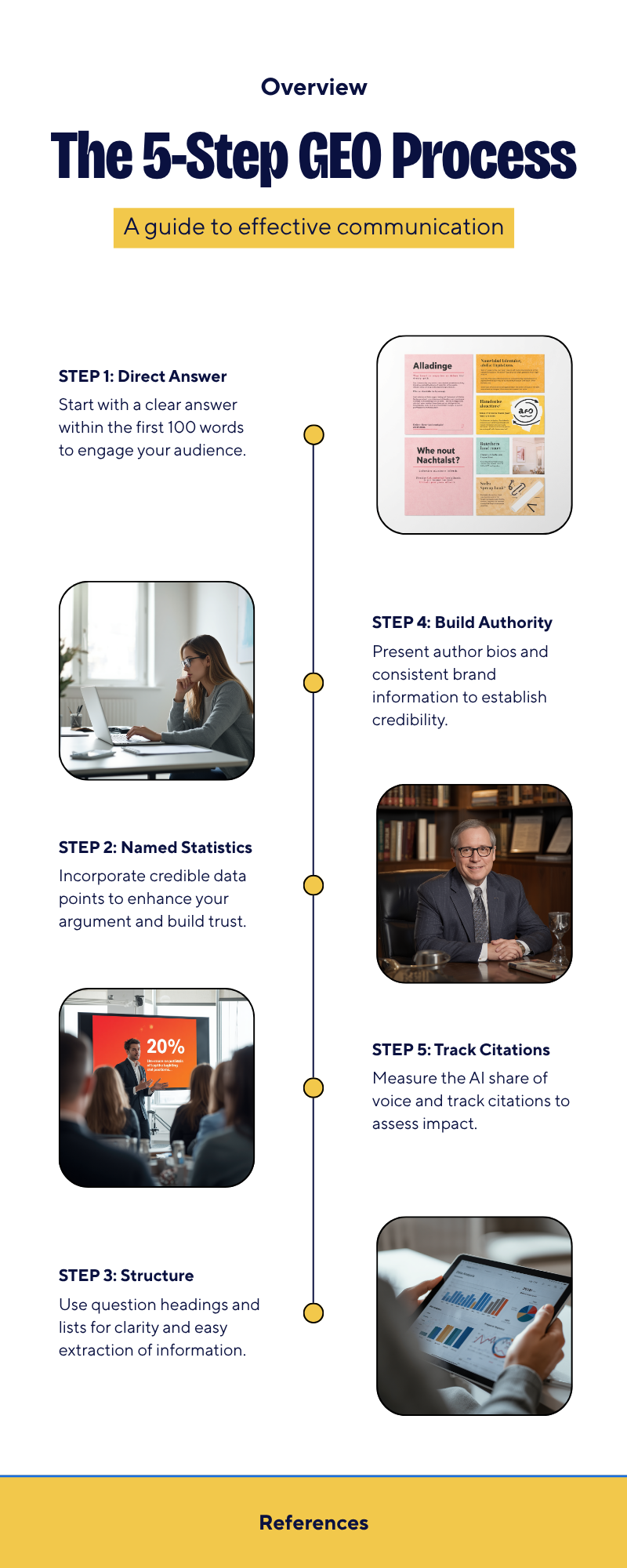
This is the layer most performance teams ignore because it does not live in the ads manager - and that is exactly why it is an edge. When a buyer asks ChatGPT or Perplexity to recommend an email tool, a protein brand or a B2B vendor, the model answers from content it can parse and trust. Getting cited there requires different work than ranking on page one.
- Structure content to answer specific questions in 40 to 70 words near the top - this is what gets lifted into AI Overviews and PAA boxes.
- Add FAQPage, Product and Organization schema so machines can extract clean facts about you.
- Publish genuinely original data, opinions and frameworks; LLMs favor distinctive, citable sources over rehashed listicles.
- Build entity authority - consistent mentions, reviews and links - so models associate your brand with your category.
This work compounds. A page that earns citations in AI search keeps delivering qualified, intent-rich traffic without a per-click cost, which is the cheapest customer acquisition you will find in 2026.
The workflow that ties it together
Tools are useless without a cadence. Here is the operating rhythm we run on managed accounts.
- Daily: check spend pacing and any campaigns in learning, but resist the urge to edit AI-driven campaigns more than twice a week - you reset their learning.
- Weekly: review creative win rate, launch the next batch of test concepts, and check blended CAC against target rather than platform-reported ROAS.
- Monthly: validate signal quality (are CAPI and offline conversions firing?), review LTV cohorts, and run or read an incrementality test to confirm the platforms are not just claiming credit for organic demand.
- Quarterly: audit the full stack, prune unused tools, and reassess channel mix against where your buyers are actually researching.
The single biggest mindset shift: measure blended performance and incrementality, not siloed last-click. When three platforms each claim the same sale, blended CAC and holdout tests are the only honest numbers you have.
FAQ
What is a performance marketing stack in 2026?
It is the connected system of data, signal, ad platforms, creative production and AI-search visibility that drives measurable acquisition. In 2026 it centers on feeding clean first-party signals into AI bidding engines like Google AI Max and Meta Advantage+, producing volume creative, and earning citations in AI Overviews - all measured against lifetime value.
How has AI search changed performance marketing?
Buyers increasingly research inside ChatGPT, Perplexity, Gemini and Google AI Overviews before clicking any ad. Google has confirmed AI Overviews appear on a large share of searches. If your brand is not represented in those answers through strong, structured, citable content, you lose influence at the moment intent forms - so AEO and GEO are now core to the stack.
Why is creative more important than targeting now?
Platforms have automated targeting through AI bidding, so the input advertisers most directly control is creative. The systems also reward volume and variety. Teams that ship 20 to 40 tested concepts a month, kill losers fast and scale winners consistently outperform those polishing a single ad. Creative is where most ad budgets are won or lost in 2026.
What should I track instead of last-click ROAS?
Track blended CAC across all channels, customer lifetime value by cohort, and incrementality from holdout tests. When multiple platforms claim the same conversion, last-click numbers mislead you. Blended performance plus periodic incrementality testing tells you whether spend is actually generating new customers or just taking credit for demand you already had.
Build a stack that fits your business
There is no universal stack - the right one depends on your margins, your sales cycle and where your buyers research. But the principles hold across budgets: clean signals first, AI-friendly activation, creative at volume, and visibility inside AI search. If you want a candid review of your current setup and a roadmap to close the gaps, talk to Balistro and we will map your 2026 stack to your numbers, not someone else's template.