
In today’s fast-paced digital world, businesses are increasingly focusing on acquiring new customers. However, when it comes to long-term growth and sustainability, customer retention has become equally, if not more, important. This is where retention marketing agencies come into play. They focus on building strong relationships with existing customers, ensuring that they remain loyal, engaged, and ready to make repeat purchases. But how do you choose the best retention marketing agency for your business? And what makes the top agencies stand out in 2025?
In this blog post, we will explore the key features and trends that define the best retention marketing agencies and how they can help your business thrive.
Why Retention Marketing is Key for Success in 2025
Retention marketing is no longer just about sending occasional promotional emails or offering discounts. It’s about crafting personalized experiences that resonate with your customers and build long-term relationships. As we move into 2025, customer expectations are higher than ever. They demand personalized communication, relevant content, and seamless experiences across various channels.
A retention-focused approach helps businesses reduce churn, improve customer lifetime value, and boost brand loyalty making it an essential strategy for success in the coming years.
The Top Features of the Best Retention Marketing Agencies
So, what makes the best retention marketing agencies stand out? The top agencies typically possess the following features:
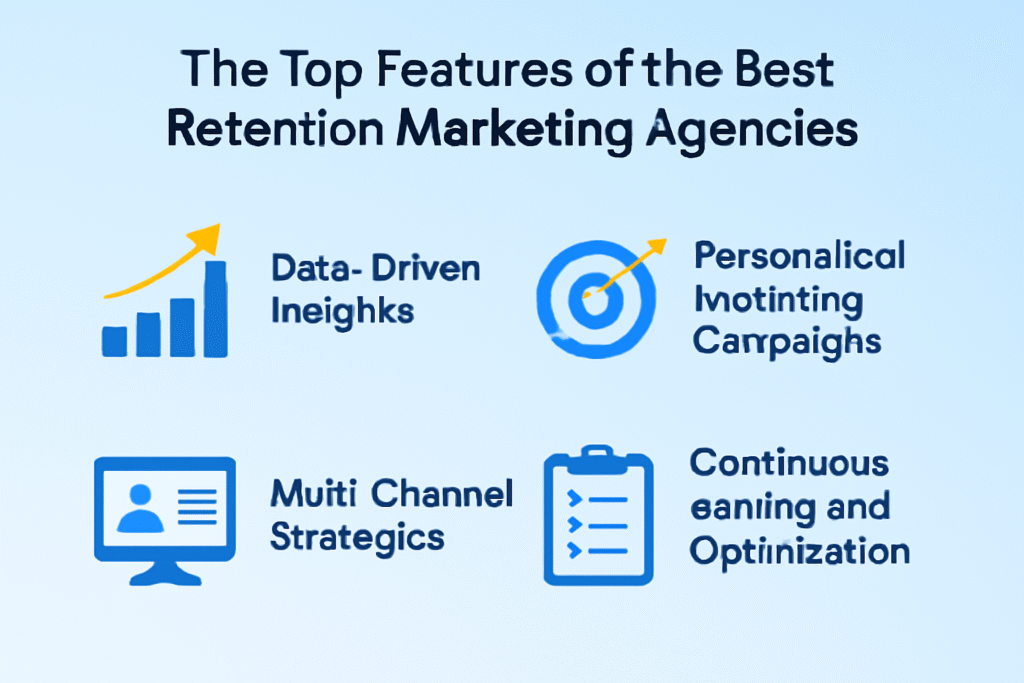
Data-Driven Insights
The best retention marketing agencies leverage advanced analytics to understand customer behavior. They use this data to personalize interactions and predict customer needs, ensuring that every engagement is timely and relevant.
Personalized Marketing Campaigns
Personalization is key to fostering strong customer relationships. The top agencies use customer segmentation, AI-driven tools, and tailored content strategies to ensure that each customer feels seen and valued.
Multi-Channel Strategies
Customers engage with brands across various platforms. Leading agencies ensure your business has a presence across email, social media, mobile apps, and more, ensuring a consistent, omnichannel experience that enhances customer retention.
Continuous Testing and Optimization
The best agencies constantly monitor the performance of their campaigns, using A/B testing and other optimization tools to refine and improve their retention strategies continuously.
Key Trends Shaping Retention Marketing in 2025
The world of marketing is always evolving, and so is the landscape of retention marketing. Here are the top trends shaping the industry in 2025:
– Artificial Intelligence (AI)
AI has revolutionized how businesses interact with customers. AI-powered tools allow retention agencies to analyze customer data, predict future behavior, and automate personalized interactions at scale. From chatbots that provide instant support to predictive analytics for customer churn, AI is changing the game.
– Predictive Analytics
Predictive analytics helps businesses understand which customers are likely to churn and which are likely to stay. By identifying these patterns early, agencies can take proactive steps to retain customers before they leave.
– Voice Search and AI Chatbots
As voice search continues to grow, integrating voice assistants and AI chatbots into retention strategies will be essential. These tools provide customers with instant, convenient support and personalized recommendations.
How the Best Agencies Foster Brand Loyalty and Engagement
Brand loyalty doesn’t happen overnight, it takes time and consistent effort. The best retention marketing agencies understand this and use a variety of strategies to foster long-term relationships with customers:
– Loyalty Programs
Offering rewards for repeat purchases is a proven way to increase customer retention. Leading agencies design creative loyalty programs that incentivize customers to return, such as offering discounts, early access to products, or exclusive content.
– Engaging Content
Engaging content is at the heart of any successful retention strategy. Top agencies create compelling stories, valuable information, and experiences that keep customers connected with the brand.
– Proactive Customer Support
Rather than waiting for customers to reach out with issues, the best agencies anticipate potential challenges and offer solutions before problems arise, ensuring that customers feel supported at every stage of their journey.
Case Studies: Successful Retention Marketing Strategies
Looking at successful retention marketing campaigns can provide valuable insights into what works. Here are a few examples:
– Starbucks Rewards Program
Starbucks has mastered the art of customer retention with its loyalty program. By offering rewards, personalized offers, and birthday surprises, Starbucks keeps customers engaged and loyal.
– Amazon’s Personalized Recommendations
Amazon uses data-driven insights to offer personalized product recommendations, which not only enhance the shopping experience but also encourage repeat purchases, leading to higher customer retention.
– Sephora’s Beauty Insider Program
Sephora’s rewards program is another great example. By offering tiered rewards, early access to products, and exclusive promotions, Sephora ensures customers keep coming back for more.
Choosing the Right Retention Marketing Agency for Your Business in 2025
When choosing a retention marketing agency for your business, consider the following:
- Experience and Expertise
Look for agencies with a proven track record in retention marketing. Check their case studies and testimonials to see how they have helped businesses similar to yours. - Advanced Tools and Technology
Ensure that the agency is using up-to-date tools, including AI and predictive analytics, to deliver personalized and effective retention strategies. - Transparent Communication
A good agency should provide clear communication about their strategies, expected results, and regular performance reports. This transparency will help you track the ROI of your retention campaigns. - Customer-Centric Approach
Finally, choose an agency that prioritizes customer experience. Their ability to create meaningful interactions that resonate with your audience will be key to your long-term retention success.
How Data and AI are Revolutionizing Retention Marketing
As AI and data analytics continue to evolve, their impact on retention marketing becomes more significant. Agencies are now able to use machine learning models to predict which customers are at risk of leaving and take preventative actions before churn happens. AI is also helping agencies personalize content and offers on an individual level, making interactions more relevant and valuable to customers.
The Role of Customer Feedback in Shaping Retention Marketing Tactics
Customer feedback is crucial in shaping retention strategies. By gathering insights through surveys, reviews, and social media comments, agencies can better understand customer needs, pain points, and desires. This data helps agencies refine their marketing tactics, ensuring they stay aligned with customer expectations.
FAQs
What is retention marketing and why is it important?
Retention marketing focuses on building long-term relationships with existing customers by delivering personalized, engaging, and valuable experiences. It’s crucial because it costs less to retain a customer than to acquire a new one, and loyal customers are more likely to make repeat purchases.
How do retention marketing agencies help businesses?
Retention marketing agencies help businesses by developing customized strategies that improve customer engagement, foster brand loyalty, and reduce churn. They use data analytics, AI, and personalized marketing techniques to ensure that businesses keep their customers happy and coming back.
What are the top trends in retention marketing for 2025?
Top trends include AI-powered tools, predictive analytics, voice search integration, and enhanced customer support systems like chatbots.
How can I choose the best retention marketing agency for my business?
Evaluate agencies based on their experience, tools, success stories, and how well they understand your business needs. Transparency and a customer-first approach are also important.
What are some successful examples of retention marketing campaigns?
Examples include Starbucks’ loyalty program, Amazon’s personalized recommendations, and Sephora’s Beauty Insider program, all of which successfully keep customers engaged and loyal.
At Balistro, we specialize in helping businesses grow through effective digital marketing strategies. From Google Ads to Meta Ads, we deliver data-driven campaigns that maximize your ROI and drive real results. If you’re looking to boost your online presence, generate leads, or scale your e-commerce business, our expert team is here to help. Contact us today to learn more about how we can support your advertising needs!
Ready to Grow Your Business?
Book a free 30-minute strategy call with Balistro. We’ll audit your marketing and show you exactly where your biggest growth opportunities are.
Why Strategic Digital Marketing Is Essential for Business Growth in India
India’s digital advertising market is projected to reach ₹62,000 crore by 2026, growing at 25% CAGR (Source: Dentsu Digital Report). This explosive growth means more businesses are competing for digital attention than ever before. Without a strategic digital marketing approach, brands risk being invisible to their target audience.
The most successful brands in India’s digital landscape don’t rely on a single channel — they build integrated marketing ecosystems. Brands using 3+ digital channels see 287% higher purchase rates than single-channel campaigns (Source: Omnisend). This multi-channel approach, when executed strategically, creates multiple touchpoints throughout the customer journey.
For D2C and B2B brands specifically, digital marketing has become the primary growth driver. With 78% of Indian businesses increasing their digital marketing budgets in 2025, the competitive landscape demands not just presence but excellence across search, social, email, and content channels.
Building an Integrated Digital Marketing Strategy
- Customer Research & Persona Development: Start with deep customer research — analyze your existing customer data, conduct surveys, review search queries, and study competitor audiences. Build detailed buyer personas including demographics, pain points, digital behavior, and preferred content formats.
- Channel Strategy & Prioritization: Not every channel is right for every business. D2C brands should prioritize Meta Ads, Google Shopping, email marketing, and SEO. B2B brands focus on Google Search, LinkedIn, content marketing, and email nurturing. Start with 2-3 core channels and expand based on data.
- Content Strategy & Calendar: Develop a content strategy that supports every stage of the funnel — awareness (blog posts, social content), consideration (case studies, comparison guides), and decision (product pages, testimonials). Create a monthly content calendar with themes aligned to business goals and seasonal opportunities.
- Paid Media Strategy: Structure paid campaigns by funnel stage with appropriate budgets. Allocate 40% to prospecting (awareness), 30% to remarketing (consideration), and 30% to conversion campaigns. Use cross-channel remarketing to nurture prospects across platforms.
- Measurement & Optimization: Implement comprehensive tracking across all channels. Build a unified dashboard that shows the complete customer journey. Use data to continuously optimize — shift budget to top-performing channels, refine targeting, and improve creative based on performance insights.
Digital Marketing Mistakes That Stunt Business Growth
- No clear strategy or goals: Running ads and posting content without a coherent strategy wastes budget and effort. Define specific, measurable goals for each channel — traffic, leads, revenue — and build campaigns that directly support those objectives.
- Channel silos: Running each marketing channel independently creates disconnected customer experiences and misses cross-channel optimization opportunities. Integrate your channels so email supports paid media, content supports SEO, and social supports brand building in a cohesive ecosystem.
- Chasing trends over fundamentals: New platforms and tactics are exciting, but sustainable growth comes from mastering fundamentals — compelling messaging, strong offers, excellent landing pages, and data-driven optimization. Build a strong foundation before experimenting with emerging channels.
- Underinvesting in retention: Most brands overspend on acquisition and underinvest in retention. Retaining existing customers costs 5-7x less than acquiring new ones. Build email automation, loyalty programs, and post-purchase experiences that maximize customer lifetime value.
- Not investing in brand: Performance marketing drives immediate results, but brand building creates long-term competitive advantage. Strong brands enjoy higher conversion rates, lower acquisition costs, and greater pricing power. Allocate at least 20-30% of marketing budget to brand-building activities.
Frequently Asked Questions
How much should a small business spend on digital marketing in India?
Small businesses in India should allocate 7-15% of revenue to digital marketing, with a minimum of ₹25,000-50,000 per month for meaningful impact. Start with the channels most likely to drive immediate revenue — Google Ads for intent-based traffic and social media ads for awareness — then expand as you see returns.
What is the most effective digital marketing channel for B2B?
For B2B companies in India, Google Search Ads and LinkedIn are typically the most effective channels for lead generation. Content marketing and SEO build long-term authority and organic lead flow. Email marketing nurtures leads through longer B2B sales cycles. The optimal mix depends on your industry, target audience, and sales process.
How do I measure digital marketing success?
Measure success against your business objectives: revenue growth, customer acquisition cost (CAC), return on ad spend (ROAS), organic traffic growth, conversion rates, and customer lifetime value (CLV). Avoid vanity metrics like impressions or followers unless they directly correlate with business outcomes. Set up proper attribution to understand which channels drive real results.
Ready to Grow Your Business?
At Balistro Consultancy, we help D2C and B2B brands achieve measurable marketing results through data-driven strategies. Whether you need Google Ads management, Facebook advertising, SEO services, or email marketing, our team of certified specialists is ready to help you grow.
Book a free consultation call to discuss your marketing goals and discover how Balistro can drive real results for your brand.