After more than 6 years in performance marketing, there’s one question that keeps coming up:
From launching campaigns at 2AM, to onboarding clients with bold visions but tight budgets, to speaking with over 200 founders and marketers while building the agency — this question always finds its way into the conversation. And for a long time, it seemed like the answer could be wrapped up neatly in one post. But the deeper the work goes, the clearer it becomes: it’s not a simple yes or no.
This blog is an honest attempt to lay it all out — not frameworks or funnel hacks — just real experiences, lessons learned, and insights observed across hundreds of brand journeys.
Let’s start with a story.
The Luméa Moment
A few months ago, the team started working with a DTC skincare brand — let’s call them Luméa.
On the very first call, the founder shared a clear vision: “We’re not chasing sales — we want to build a brand people fall in love with.”
Everything seemed in place:
-Beautiful branding
-Soft pastel visuals
-Poetic, emotional copy
-Ads that looked like mini art films
Everything was perfectly polished. Visually stunning. Completely “on-brand.” But two weeks into the campaign? Silence. Low CTR. High CPC. Almost no conversions. Late one night, a message came through from the founder: “We’re doing everything right. Why isn’t it working?” That moment was a turning point. Because technically, yes — they were doing everything “right” if the audience already knew them.
But they didn’t.
The campaign was targeting cold traffic. People who had never heard of Luméa. People who weren’t moved by soft visuals or poetic lines. These users needed something else: relevance, trust, and a clear reason to pay attention.
What was happening? They were trying to build a brand by looking like a brand.
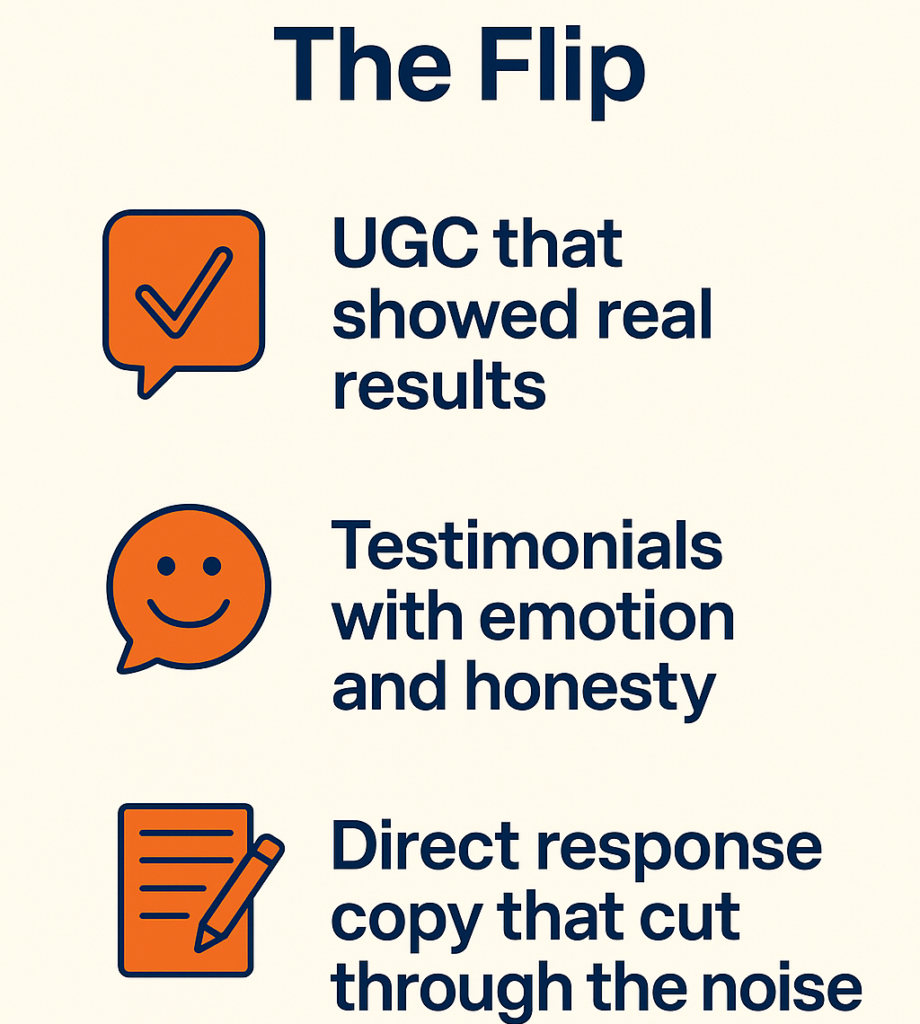
The Flip
The strategy had to change.
The polished creatives were paused. The team leaned into real, raw, and relatable content. They used:
-UGC that showed real results
-Testimonials with emotion and honesty
-Direct response copy that cut through the noise
The messaging shifted — no more fluff. It was about the user’s pain point, the transformation, the proof. One of the highest-performing ads said: “This fixed my skin in 10 days — and it’s not what you think.” Suddenly, results started to show. Clicks increased. Orders came in. Comments lit up with real feedback.
This feedback loop became the foundation for the brand to evolve. The copy improved. The product messaging sharpened. The brand voice matured.
In this process, performance marketing wasn’t just a sales engine. It became a mirror — reflecting what was resonating and what wasn’t.
Can Performance Marketing Build a Brand?
Yes. But not in the way most people think.
Performance marketing can be a powerful part of a brand-building journey. It helps to:
-Find early adopters
-Discover which messages resonate
-Identify what the market really values
But here’s the catch:
If 90% of your sales are coming from Meta and Google, that’s not your sale — that’s Meta and Google’s sale. If you stop paid campaigns today and your revenue drops tomorrow, you don’t have a brand — you have a paid acquisition loop. Until organic demand starts to show up — until there’s word of mouth, repeat search, and direct traffic — the brand hasn’t really been built.
In rare cases, a product or service is so exceptional that it naturally builds word of mouth. But for most businesses, performance is the spark, not the fire.
Use it to learn. Use it to grow. But don’t assume ROAS is the same thing as brand equity.
Why Most Early-Stage Brands Get Performance Marketing Wrong
This is where many new brands struggle.
They come in with beautiful branding and strong intentions — but they focus too much on how they look and not enough on how they connect. Let’s take another hypothetical brand — a sustainable shoe startup called TerraStep.
They launched with stunning visuals, a sleek website, and eco-friendly messaging. But every ad looked like a magazine cover. There was no clear hook, no urgency, no emotional pull.
We adjusted their approach by:
-Running UGC videos from customers sharing their personal switch to TerraStep
-Rewriting messaging from “eco-conscious blend” to “shoes that don’t smell after a long day”
-Adding low-friction CTAs like “Try them for 30 days — or get your money back”
CTR tripled. Conversion rates climbed. And the brand started to feel more human.
The lesson: In the early stage, branding without clarity is just noise. Relevance > Refinement.
The market doesn’t care how clean your logo is — it cares about why you matter.
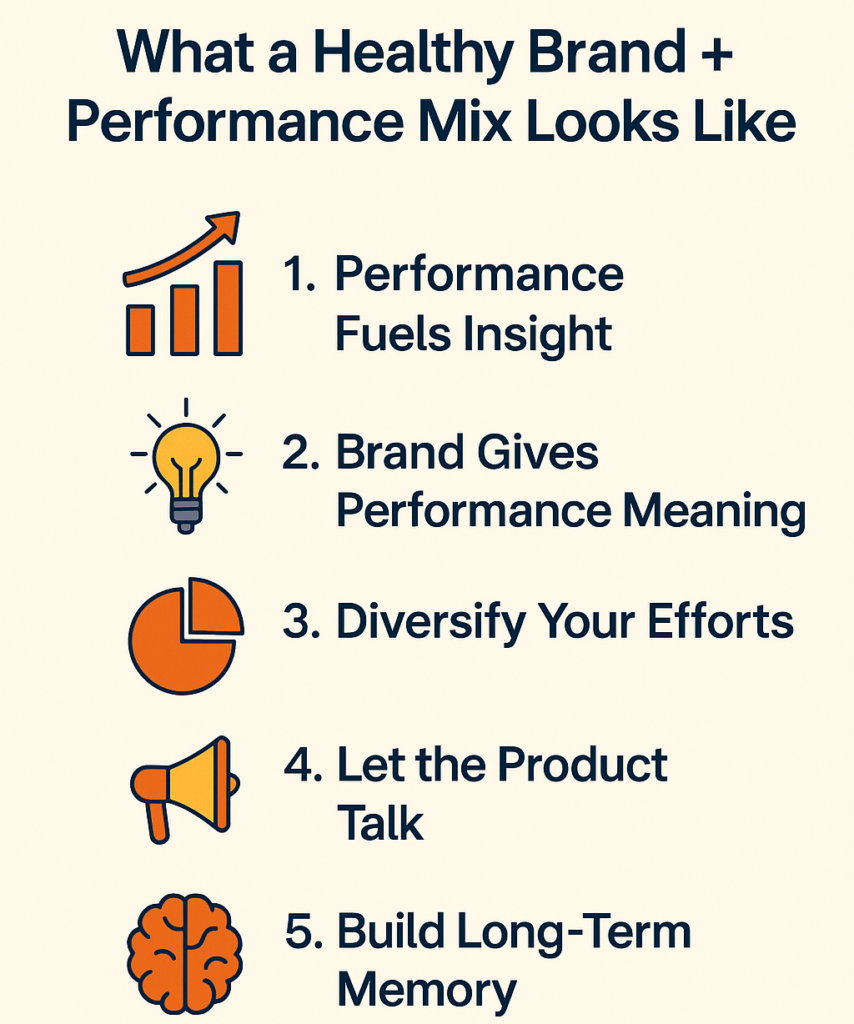
What a Healthy Brand + Performance Marketing Mix Looks Like
So what happens when performance and brand actually work together?
Here’s what a sustainable, well-balanced growth mix often includes:
1. Performance Fuels Insight
If you’re a protein brand and “gut health” converts better than “muscle gain,” your ads just uncovered your messaging sweet spot. That becomes your product positioning, your landing page copy, your content focus — it drives the brand forward.
2. Brand Gives Performance Meaning
Once performance tells you what’s clicking, brand steps in to refine it. Your tone sharpens. Your visuals align. You don’t just run what works — you evolve it into something bigger.
3. Diversify Your Efforts
A healthy brand doesn’t rely on one source. Here’s a common media mix:
-40% Paid acquisition (Meta, Google, TikTok)
-20% Retention (email, SMS)
-20% Organic (SEO, blog, social content)
-10% Community & storytelling
-10% Experiments (referrals, collabs)
4. Let the Product Talk
Encourage customer reviews. Showcase transformations. Use every sale as an opportunity to create social proof.
5. Build Long-Term Memory
Ask: If we stopped ads tomorrow, who would still talk about us? If the answer is “no one,” it’s time to start planting seeds beyond the ad platform.
When performance and brand align — CAC drops, loyalty rises, and you’re not just scaling a funnel. You’re building a foundation.
What Comes Next?
When momentum builds, the goal shifts from scaling ads to scaling impact.
This looks like:
-Launching content that educates, not just sells
-Building a community around shared values
-Creating founder-led content or BTS stories
-Leveraging user stories and UGC to extend reach organically
One brand we worked with began posting raw, weekly Q&As from the founder — answering real questions, sharing wins and mistakes. It built trust, sparked shares, and slowly shifted them from a product company to a story-driven brand.
That’s how it starts. Not with noise — with honesty.
Final Thoughts on Performance Marketing
Performance marketing is powerful. It gets attention. It brings people in.
But it doesn’t build trust. That’s the job of a brand.
Used together, performance shows what matters — and brand makes it matter more.
If your entire business depends on paid media, you’re renting your growth. If your brand starts to grow even when the ads stop — that’s when you know it’s real.
Performance can be the beginning of a great brand. But it’s not the whole story.
Start there. But don’t stop there.
At Balistro, we specialize in helping businesses grow through effective digital marketing strategies. From Google Ads to Meta Ads, we deliver data-driven campaigns that maximize your ROI and drive real results. If you’re looking to boost your online presence, generate leads, or scale your e-commerce business, our expert team is here to help. Contact us today to learn more about how we can support your advertising needs!
Ready to Grow Your Business?
Book a free 30-minute strategy call with Balistro. We’ll audit your marketing and show you exactly where your biggest growth opportunities are.
Why Performance Marketing Is the Growth Engine for Modern Brands
Performance marketing has fundamentally changed how brands approach advertising — shifting from paying for impressions to paying for measurable outcomes like clicks, leads, and sales. This accountability makes every rupee of marketing spend trackable and optimizable, which is why performance-based digital marketing now accounts for 65% of total digital ad spend in India (Source: IAMAI).
For D2C brands in India’s rapidly growing e-commerce market, performance marketing is the primary customer acquisition engine. The ability to test multiple channels — Google Ads, Meta Ads, programmatic, affiliate marketing — and allocate budget to the highest-performing channels in real-time is a competitive advantage that traditional advertising simply cannot match.
The integration of AI and machine learning into performance marketing platforms has accelerated optimization cycles. Automated bidding, dynamic creative optimization, and predictive audience modeling allow brands to achieve better results faster, with algorithms processing thousands of data points to find the most efficient path to conversion.
Building a Performance Marketing Framework That Scales
- Define Clear KPIs & Attribution: Establish your primary KPIs — ROAS for e-commerce, CPL for B2B, CAC for subscription businesses. Set up multi-touch attribution modeling to understand the true contribution of each channel. Avoid last-click attribution which overvalues bottom-funnel channels.
- Channel Mix Strategy: Start with 2-3 channels and expand based on performance data. For most Indian D2C brands, Google Search + Meta Ads is the optimal starting combination. Add Google Shopping, YouTube, and programmatic as you scale. B2B brands should prioritize Google Search + LinkedIn Ads.
- Creative Testing Framework: Develop a systematic creative testing process. Test hooks (first 3 seconds of video, headline of static ads), value propositions, social proof elements, and CTAs. Run 3-5 creative variations per ad set and replace underperformers weekly.
- Budget Allocation & Scaling: Use a 70/20/10 framework — 70% of budget on proven campaigns, 20% on promising tests, 10% on experimental channels. Scale winning campaigns by increasing budget 20-30% every 3-5 days while maintaining ROAS targets.
- Measurement & Optimization Cadence: Review campaign performance daily (budget pacing, anomalies), optimize weekly (bid adjustments, creative swaps, audience refinements), and conduct strategic reviews monthly (channel allocation, funnel analysis, competitive landscape).
Performance Marketing Mistakes That Waste Your Ad Budget
- Optimizing for vanity metrics: Impressions, clicks, and even CTR are vanity metrics if they don’t translate to revenue. Always optimize campaigns for conversion events that align with business outcomes — purchases, qualified leads, or revenue.
- Not investing in landing page optimization: Sending paid traffic to generic homepages or poorly designed landing pages wastes acquisition costs. Create dedicated landing pages for each campaign with clear value propositions, social proof, and frictionless conversion paths.
- Scaling too fast: Dramatically increasing budgets overnight disrupts campaign learning and often tanks performance. Scale gradually — 20-30% budget increases every few days — and monitor performance metrics closely during scaling periods.
- Ignoring the full funnel: Brands that only run bottom-funnel conversion campaigns eventually exhaust their addressable audience. Build awareness and consideration campaigns to feed the top of funnel and create sustainable acquisition growth.
- Poor tracking and attribution: Without accurate conversion tracking across all touchpoints, you can’t make informed optimization decisions. Implement server-side tracking, cross-device attribution, and proper UTM tagging before scaling ad spend.
Frequently Asked Questions
What is a good ROAS for performance marketing?
A good ROAS varies by industry and business model. E-commerce D2C brands typically target 3-5x ROAS, while high-margin businesses can be profitable at 2x. B2B companies often measure success through cost-per-lead rather than ROAS. The key is ensuring your ROAS exceeds your break-even point accounting for product costs, overhead, and customer lifetime value.
How is performance marketing different from digital marketing?
Performance marketing is a subset of digital marketing specifically focused on measurable, results-driven campaigns where you pay for specific outcomes. Digital marketing is broader and includes brand building, content marketing, SEO, and other activities that may not have direct, immediate ROI attribution. Performance marketing prioritizes accountability and data-driven optimization above all else.
How much should I budget for performance marketing?
For D2C brands in India, a starting budget of ₹50,000-₹1,50,000 per month across Google and Meta Ads provides enough data for optimization. B2B brands can start at ₹30,000-₹75,000 per month. Scale budget based on profitability — if campaigns are generating positive ROAS, increase spend systematically to capture more market share.
Ready to Grow Your Business?
At Balistro Consultancy, we help D2C and B2B brands achieve measurable marketing results through data-driven strategies. Whether you need Google Ads management, Facebook advertising, SEO services, or email marketing, our team of certified specialists is ready to help you grow.
Book a free consultation call to discuss your marketing goals and discover how Balistro can drive real results for your brand.