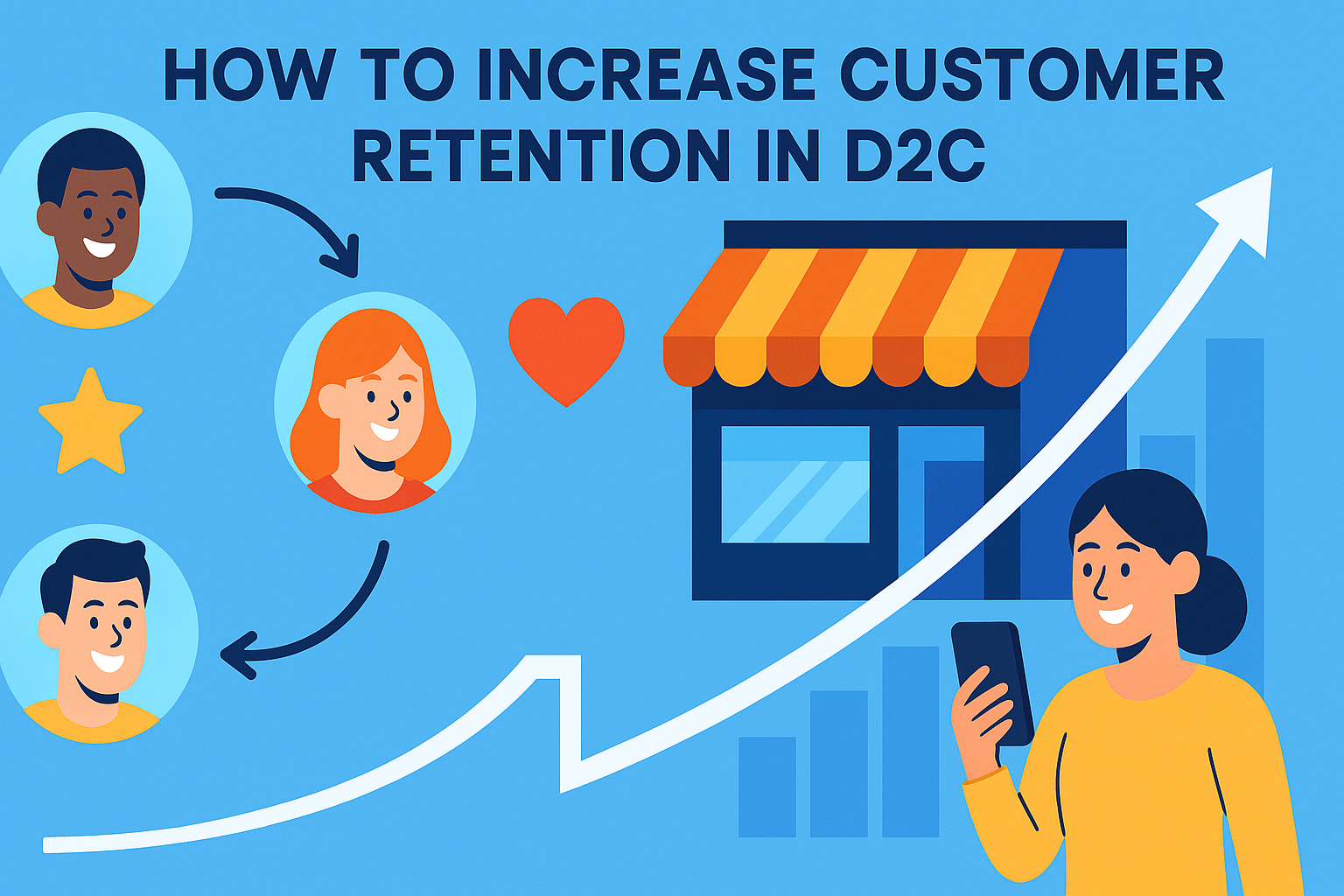
Acquiring a new customer costs 5-7x more than retaining an existing one. Yet most D2C brands pour 80% of their marketing budget into acquisition and barely 20% into retention. This imbalance is why so many direct-to-consumer businesses struggle with profitability — they’re stuck on a CAC treadmill, constantly spending to replace churning customers.
Customer Lifetime Value (CLV) is the total revenue a customer generates over their entire relationship with your brand. For D2C brands, increasing CLV is the single most impactful lever for profitability. A 5% increase in customer retention can boost profits by 25-95%, according to research by Bain & Company.
In this guide, we break down 8 proven strategies to increase customer lifetime value for D2C brands — with specific implementation steps, tools, benchmarks, and real-world CLV impact percentages.
Understanding Customer Lifetime Value for D2C Brands
Before implementing strategies, let’s establish the CLV formula and benchmarks:
CLV = Average Order Value (AOV) x Purchase Frequency x Customer Lifespan
For Indian D2C brands, typical benchmarks are:
- Average Order Value: Rs 800-2,500 (varies by category)
- Purchase Frequency: 1.5-3x per year (beauty and personal care skew higher at 4-6x)
- Customer Lifespan: 1.5-3 years for most D2C categories
- Average CLV: Rs 3,000-15,000 depending on category and brand strength
Every strategy below targets at least one of these three variables — increasing order value, increasing purchase frequency, or extending customer lifespan.
1. Post-Purchase Email Automation Sequences
Post-purchase email automation is the highest-ROI retention strategy available to D2C brands. According to Klaviyo’s benchmark data, post-purchase flows generate 3-5x more revenue per recipient than standard promotional campaigns. Yet 62% of D2C brands either don’t have post-purchase automation or have only a basic order confirmation email.
The Complete Post-Purchase Flow
- Email 1 (Immediately): Order confirmation with delivery timeline and customer support contact
- Email 2 (Day 2): Brand story email — share your mission, founder story, and social proof. This builds emotional connection during the excitement window
- Email 3 (Day 5-7): Product education — how to use/care for the product, tips for best results. Reduces returns and increases satisfaction
- Email 4 (Day 14): Review request with incentive (10% off next order for leaving a review). This captures social proof while driving repeat purchase
- Email 5 (Day 21): Cross-sell recommendation based on purchase history. “Customers who bought X also loved Y”
- Email 6 (Day 30-45): Replenishment reminder (for consumable products) or “something new” product launch email
Tools Needed
Klaviyo (recommended for Shopify stores), ActiveCampaign, or Mailchimp. Integration with your e-commerce platform is essential for behavioral triggers and product data.
CLV Impact
D2C brands implementing a complete 6-email post-purchase sequence typically see a 15-25% increase in repeat purchase rate within the first 90 days. For a brand with Rs 2,000 AOV and 10,000 monthly orders, this translates to Rs 30-50 lakh in additional annual revenue from email marketing automation alone.
2. Loyalty and Rewards Programs
Loyalty programs fundamentally change customer behavior by making every purchase feel like progress toward a reward. Research shows that loyalty program members spend 12-18% more per transaction and purchase 33% more frequently than non-members. For D2C brands, loyalty programs also provide invaluable zero-party data about customer preferences.
Implementation Steps
- Points system: Award 1 point per Rs 10 spent. Set redemption at 100 points = Rs 100 off. This 10% effective reward rate is the sweet spot — generous enough to drive engagement without destroying margins
- Tier structure: Create 3 tiers (Silver, Gold, Platinum) based on annual spend. Each tier unlocks progressively better benefits — early access, exclusive products, free shipping, birthday rewards
- Non-purchase earning: Award points for social shares (25 points), reviews (50 points), referrals (200 points), and email signups (10 points). This gamifies engagement beyond transactions
- VIP experiences: Top-tier members get exclusive perks: early access to launches, invite-only events, personal shopping consultations, and surprise gifts. These emotional benefits often matter more than monetary rewards
- Communication: Send monthly points balance updates and “points about to expire” urgency emails to drive redemption
Tools Needed
Smile.io, LoyaltyLion, or Yotpo Loyalty for Shopify. For custom platforms, consider building on a flexible API like Open Loyalty.
CLV Impact
Well-implemented loyalty programs increase CLV by 20-30% through combined effects of higher AOV (members spend more per order) and higher purchase frequency (points create urgency to earn and redeem). Indian D2C brands like Nykaa, Mamaearth, and Sugar Cosmetics have demonstrated that loyalty programs are critical infrastructure for retention-driven growth.
3. Subscription and Auto-Replenishment Models
Subscription models convert one-time buyers into recurring revenue streams, dramatically increasing both purchase frequency and customer lifespan. The subscription e-commerce market in India is growing at 30%+ annually, and D2C brands in categories like health supplements, skincare, coffee, pet food, and personal care are perfectly positioned to capitalize.
Implementation Steps
- Subscribe-and-save discount: Offer 10-15% off the regular price for subscribers. This is your primary incentive. Position it as “subscribe and save” prominently on product pages
- Flexible frequency: Let customers choose delivery frequency (weekly, biweekly, monthly, bimonthly). Rigid schedules cause cancellations when customers accumulate excess product
- Easy management: A self-service portal where customers can skip, pause, swap products, or change frequency is non-negotiable. Difficult cancellation experiences destroy trust and generate negative reviews
- Curated boxes: For non-consumable categories, consider discovery-style subscriptions where you curate a themed box monthly. This adds novelty and surprise to the subscription experience
- Free gift on commitment: Offer a bonus product for customers who commit to 3+ months upfront. This reduces early churn during the critical first 90 days
Tools Needed
ReCharge Payments, Bold Subscriptions, or Chargebee for Shopify. WooCommerce stores can use WooCommerce Subscriptions or Subbly.
CLV Impact
Subscription customers have 200-300% higher CLV than one-time buyers. The average subscription customer stays 6-12 months (vs. 1-2 purchases for non-subscribers). For a D2C brand with Rs 1,500 monthly subscription value, a subscriber who stays 8 months generates Rs 12,000 CLV — compared to Rs 2,000-3,000 from a typical non-subscriber.
4. Cross-Sell and Upsell Flows
Cross-selling (recommending complementary products) and upselling (recommending premium alternatives) are the fastest ways to increase Average Order Value. Amazon attributes 35% of its revenue to cross-sell and upsell recommendations. For D2C brands, even basic implementation can increase AOV by 10-30%.
Implementation Steps
- Product page upsells: Show a premium version or bundle option on every product page. “Upgrade to the 200ml bottle and save 20% per ml” is a classic upsell
- Cart cross-sells: When a customer adds a product to cart, suggest 2-3 complementary items. Keep suggestions relevant — a face wash customer should see moisturizer, not an unrelated category
- Post-purchase cross-sell: On the thank-you page (highest engagement moment), offer a one-click upsell at a limited-time discount. Conversion rates of 5-15% are common on well-optimized thank-you page offers
- Email cross-sell sequences: 14-21 days after purchase, send personalized cross-sell emails based on the product purchased. Use dynamic product blocks showing “frequently bought together” items
- Bundle offers: Create curated bundles that include a hero product plus 2-3 complementary items at a 15-20% bundle discount. Bundles increase AOV while providing perceived value
Tools Needed
Rebuy, Bold Product Upsell, or ReConvert for Shopify. For email-based cross-sells, Klaviyo’s product recommendation engine is excellent.
CLV Impact
Effective cross-sell and upsell implementation increases AOV by 10-30% and repeat purchase rate by 5-15% (customers who buy bundles are more invested and more likely to return). Combined CLV impact: 15-40% increase. The ROI is exceptional because you’re increasing revenue from existing customers without additional acquisition cost.
5. Personalized Product Recommendations
Generic “bestseller” recommendations are leaving money on the table. AI-powered personalized recommendations based on browsing history, purchase history, and behavioral data deliver 2-3x higher click-through rates and 150% higher conversion rates than non-personalized suggestions.
Implementation Steps
- On-site personalization: Implement AI-powered recommendation widgets on homepage (“Recommended for you”), product pages (“Customers also viewed”), and collection pages (“Based on your browsing”)
- Email personalization: Dynamic product blocks in emails that automatically populate based on each recipient’s browsing and purchase history
- Quiz-based recommendations: Build an interactive quiz (“Find your perfect skincare routine”) that collects preference data and generates personalized product recommendations. Quiz funnels convert at 4-5x the rate of standard product pages
- Retargeting personalization: Use Facebook and Google dynamic remarketing ads that show products the customer viewed but didn’t purchase, plus complementary items
- SMS recommendations: For high-intent segments, personalized SMS recommendations with exclusive offers drive immediate action (SMS has 98% open rate vs. 20-25% for email)
Tools Needed
Nosto, Rebuy, or Clerk.io for on-site recommendations. Klaviyo for email personalization. Octane AI for quiz funnels. Your data analytics infrastructure should capture behavioral events to power these recommendations.
CLV Impact
D2C brands implementing personalized recommendations across all touchpoints see 15-25% increase in CLV through higher AOV (more relevant products = more add-to-carts) and higher purchase frequency (relevant outreach drives more return visits). The key is consistency across channels — personalization on your website should match personalization in emails and ads.
6. Community Building and Brand Advocacy
Community-driven D2C brands have fundamentally higher CLV because customers don’t just buy products — they join a tribe. Brands like Lenskart, boAt, and Wakefit have built massive communities that drive organic word-of-mouth, reduce marketing costs, and create customers who stay for years rather than months.
Implementation Steps
- Social media community: Create a private Facebook Group or Discord server for customers. This is not a sales channel — it’s a space for product tips, customer stories, and genuine conversation
- User-generated content (UGC): Encourage customers to share photos and videos using your products with a branded hashtag. Feature UGC on your website, emails, and social media. UGC has 4.5x higher conversion rates than branded content
- Brand ambassador program: Identify your most engaged customers and invite them to become ambassadors. Provide exclusive perks, early access, and a referral commission (typically 10-15%)
- Content co-creation: Involve community members in product development — polls on new flavors, votes on packaging designs, beta testing for new products. This builds ownership and loyalty
- Offline events: Host meetups, workshops, or pop-up experiences in key cities (Mumbai, Delhi, Bangalore). Physical experiences create emotional bonds that digital interactions cannot replicate
Tools Needed
Facebook Groups or Discord (free). Bremember or Gatsby for ambassador program management. Yotpo or Stamped.io for UGC collection and display.
CLV Impact
Community members have 2-4x higher CLV than non-community customers. They purchase more frequently, spend more per order, are less price-sensitive, and refer 3-5 new customers on average. The compounding effect of referrals means community building delivers the highest long-term ROI of any retention strategy, though it requires 6-12 months to build meaningful momentum.
7. Customer Feedback Loop and Experience Optimization
Most D2C brands collect customer feedback reactively (support tickets, negative reviews) rather than proactively. A structured feedback loop that systematically collects, analyzes, and acts on customer insights reduces churn by 10-15% and increases repeat purchase rate by 20%+. The simple act of asking for feedback makes customers feel valued and increases their emotional investment in your brand.
Implementation Steps
- Post-purchase NPS survey: Send a Net Promoter Score survey 7-14 days after delivery (enough time to use the product). One question: “How likely are you to recommend us to a friend?” Follow up with an open-ended “Why?”
- Detractor recovery: Any NPS score of 6 or below triggers an immediate personal outreach from your customer success team. Offer to make it right — replacement, refund, or discount. Converting a detractor into a promoter creates a fiercely loyal customer
- Product improvement: Categorize feedback themes monthly (packaging, product quality, delivery experience, sizing, etc.). Prioritize the top 3 issues and fix them. Then tell customers you fixed them — “You asked, we listened” campaigns drive incredible engagement
- Review mining: Analyze positive reviews to identify your brand’s key differentiators. Use this language in your marketing — customers describe your value better than you can
- Customer advisory board: Invite 10-15 top customers to a quarterly virtual advisory session. Share upcoming plans and get direct feedback. These customers become your most loyal advocates
Tools Needed
Delighted or Typeform for NPS surveys. Zendesk or Freshdesk for support ticket analysis. Yotpo or Judge.me for review collection. Google Sheets for manual feedback categorization (start simple before investing in expensive tools).
CLV Impact
Proactive feedback management reduces churn by 10-15% (by catching and resolving issues before customers silently leave) and increases repeat purchase rate by 15-20% (customers who feel heard are more loyal). The net CLV increase is typically 20-30%, with the added benefit of reduced negative reviews and improved brand reputation.
8. VIP and Tier-Based Programs
VIP programs go beyond standard loyalty points by creating exclusive experiences and recognition for your highest-value customers. The top 10% of customers typically generate 40-50% of a D2C brand’s revenue — treating them differently isn’t just good business, it’s essential for protecting your most valuable revenue stream.
Implementation Steps
- Automatic tier assignment: Use annual spend thresholds to automatically assign customers to tiers. Example: Silver (Rs 0-5,000), Gold (Rs 5,001-15,000), Platinum (Rs 15,001+). Make thresholds achievable but meaningful
- Exclusive benefits by tier:
- Silver: Free shipping on orders above Rs 999, birthday discount (10% off)
- Gold: Free shipping on all orders, birthday gift (free product), early access to sales (24 hours before public), 15% off during member-only events
- Platinum: Everything in Gold plus free express shipping, dedicated WhatsApp support line, exclusive product drops, surprise gifts quarterly, invitation to brand events
- Status communication: Send tier upgrade celebration emails. “Congratulations — you’ve reached Gold status!” with a visual card showing their new benefits. This triggers dopamine and reinforces continued spending
- Tier maintenance motivation: 60 days before a customer’s tier renewal date, send a reminder showing how close they are to maintaining or upgrading their tier. “You’re Rs 2,000 away from keeping your Platinum status” creates powerful urgency
- Surprise and delight: For Platinum customers, send unexpected gifts — handwritten notes, exclusive samples, or early access to unreleased products. The element of surprise creates stories customers share with friends
Tools Needed
Smile.io Premium, LoyaltyLion, or Yotpo Loyalty for tier management. Klaviyo or ActiveCampaign for tier-specific email flows. A CRM or CDP (Customer Data Platform) to track customer lifetime spend across channels.
CLV Impact
VIP programs increase top-tier customer CLV by 25-40% through increased purchase frequency (maintaining status requires continued spending) and higher AOV (VIP customers feel justified spending more). More importantly, they reduce top-customer churn by 30-50% — protecting the revenue that matters most. For a D2C brand where top 10% of customers generate Rs 50 lakh annually, a 25% CLV increase on this segment alone adds Rs 12.5 lakh per year.
Measuring CLV Improvement: The Metrics That Matter
As you implement these strategies, track these metrics monthly to measure CLV improvement:
- Repeat purchase rate: Percentage of customers who make a second purchase (target: 25-40% for D2C)
- Purchase frequency: Average number of orders per customer per year
- Average order value: Track separately for first purchase vs. repeat purchases
- Customer retention rate: Percentage of customers active in the last 12 months
- Time between purchases: Decreasing inter-purchase interval indicates improving frequency
- CLV:CAC ratio: Aim for 3:1 or higher. If CLV is less than 3x your customer acquisition cost, you’re not profitable
Use your data analytics dashboards to track these metrics cohort by cohort. Not all customers are equal — segment by acquisition channel, first product purchased, and geography to identify which segments have the highest and lowest CLV.
Start with One Strategy, Then Stack
Don’t try to implement all 8 strategies simultaneously. Start with the highest-impact, lowest-effort option for your brand:
- Quick wins (Week 1-2): Set up post-purchase email automation and basic cross-sell flows
- Foundation (Month 1-2): Launch a loyalty program and implement personalized product recommendations
- Growth (Month 3-6): Build community, implement feedback loops, and test subscription models
- Scale (Month 6-12): Roll out VIP tiers and optimize every strategy based on data
Each strategy compounds on the others. Email automation drives repeat purchases, loyalty programs incentivize higher spending, community building creates advocacy, and VIP programs protect your most valuable customers. Together, they can increase your CLV by 50-100% within 12 months.
Ready to Implement These Strategies?
At Balistro Consultancy, we help D2C and B2B brands implement data-driven marketing strategies that deliver measurable results. Our certified specialists manage over ₹50 lakh in monthly ad spend across Google Ads, Facebook Ads, SEO, email marketing, and data analytics.
Book a free consultation to discuss how we can help your brand grow.